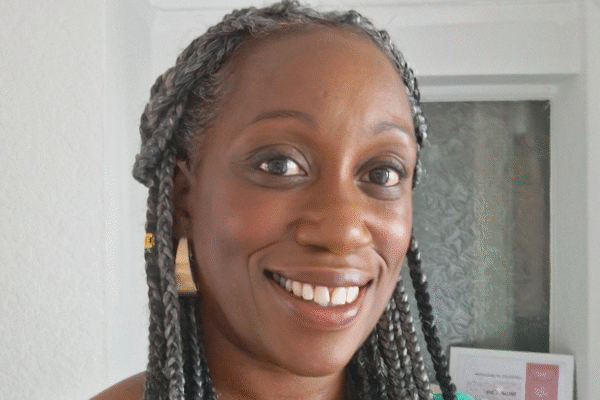
Introducing our new Racial Justice Officer, Keziah Gitonga
I am deeply honoured to accept the appointment as Racial Justice Officer for the Diocese of Liverpool and Liverpool Cathedral. For me, this role is more than a professional opportunity; it is a calling rooted in faith, lived experience and a long-standing commitment to dignity, equality and justice, sustained through personal devotion and prayer.
My involvement in Christian Aid sparked my introduction into social justice; being involved in campaigns such as: Make Poverty History and the IF Campaign, deepened my understanding of structural injustice and strengthened my desire to connect faith with practical action. Most recently, the Directions Course helped me see more clearly that my work, faith and lived experience were all leading towards this vocation.
As an African migrant who has lived in Liverpool for over twenty years, I have known both the gift of belonging and the challenges faced by racially minoritised communities. Liverpool is a city of resilience and compassion, yet, like many places, it continues to wrestle with questions of inclusion, opportunity and racial justice. These realities have shaped both my perspective and my sense of vocation.
Across my work in schools, colleges, charities and community settings, I have supported people to recognise their strengths, overcome barriers and fulfil their potential. I have often been the only person from a Global Majority background in those spaces, and that experience has deepened my conviction that representation matters. Sometimes simply being present can help widen the path for others.
Raised in a Christian home and shaped by studies in law and public international law, my professional journey has always been linked to service and advocacy. Earlier in my career with the British Red Cross, I supported families separated by war, disaster and forced migration. That work brought me face to face with profound suffering, but also with extraordinary resilience and hope.
Helping families reconnect with loved ones taught me that justice is never abstract. It is deeply human. It means recognising our shared humanity, refusing to look away from suffering, and walking alongside people with compassion. In the words of Wangari Maathai, “Human rights are not things that are put on the table for people to enjoy. These are things you fight for and then you protect.”
One lesson I carry into this role is that justice work must always make room for humanity, humour and hope. Compassion often begins in small, ordinary acts: listening well, sharing time, offering encouragement and reminding people that they are not alone. Joy and justice belong together.
In later roles with Help for Heroes and Migrant Help, I supported British veterans, Afghan families, asylum seekers and vulnerable migrants as they navigated displacement, new identity, lack of provision, mental health, resettlement and complex systems. These experiences strengthened my skills in advocacy, safeguarding, partnership working and community engagement, and confirmed my belief that meaningful support begins with listening.
Throughout my career and voluntary service, including work with Soroptimist International UN Women UK and Migrant Voice, I have remained committed to fairness, dignity and collective action. I have seen how storytelling, solidarity and advocacy can challenge exclusion and create meaningful change.
I currently serve on a steering group for Migrant Voice, helping to amplify migrant voices and challenge visa costs that place heavy emotional and financial burdens on families. Through this work, I have seen the power of storytelling, advocacy and solidarity to bring change.
My commitment to racial justice is inseparable from my identity as a Christian, a mother and a member of my local church. I believe in a God of love, compassion and justice who calls us to stand with those who are marginalised and to challenge injustice wherever it exists. Rosa Parks’ vision of “freedom and equality and justice and prosperity for all people” continues to resonate deeply with me. I am committed to seeing UKME communities recognised, welcomed and fully incorporated in all aspects of worship, leadership and service, so that the Church more faithfully reflects the body of Christ.
As I begin this role, I do so with humility, hope and determination. I want to help create spaces for dialogue, education and understanding across generations and cultures, and to encourage young people from diverse backgrounds to see themselves reflected in leadership, ministry and community life. I also hold close Doreen Lawrence’s hope for “an inclusive society for everyone to live their best life, regardless of gender, race, sexuality, religion, disability or background.”
I look forward to working with colleagues, clergy, congregations, schools, universities, interfaith communities and UKME communities across the Diocese to build a more just, inclusive and compassionate Church. Real change requires more than statements; it requires commitment, accountability, listening and the willingness to grow together. As Maya Angelou observed, “equal rights, fair play, justice, are all like the air: we all have it, or none of us has it.” That truth must be visible not only in what we say, but in worship, leadership and service.
My prayer is that together we will reflect the love of Christ in practical ways: by listening deeply, welcoming generously, speaking courageously and acting justly. As Scripture reminds us, “There is neither Jew nor Gentile… for you are all one in Christ Jesus” (Galatians 3:28), and we are called to “act justly, love mercy, and walk humbly with your God” (Micah 6:8).