Written by Racial Justice Officer, Keziah Gitonga
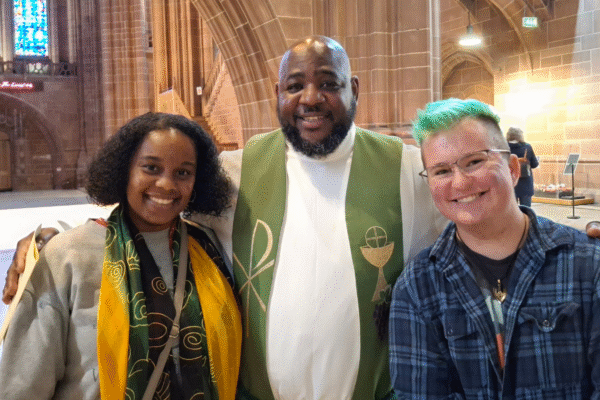
“Confession time. I stepped into the role of Racial Justice Officer for the Diocese of Liverpool not long ago, and this is my very first Black History Month leading the charge. I have the nervous energy of someone hosting Christmas dinner for the first time, except instead of gravy I am worrying about getting every word right when I stand up to preach at our Black History Month service. But for me this is bigger than nerves. My work is rooted in spiritual reparations, and that means this month cannot be a one week wonder we admire from a distance. It has to be embedded, in our worship, our schools and our everyday diocesan life.
This month matters to racial justice work precisely because it does not happen by accident. Behind every lecture, service and memorial is a racial justice team working tirelessly, quietly, and often without much thanks, to make sure it all runs smoothly. Black History Month is one visible, joyful sign of a much longer, less visible commitment: the daily work of building a diocese where racial justice is not seasonal.
What is Black History Month, Anyway?
Quick history lesson, promise it is a short one. Black History Month UK was founded in 1987 by Akyaaba Addai Sebo, a Ghanaian analyst and activist working at the Greater London Council. The story goes that a colleague came into work heartbroken because her young son, named after Marcus Garvey, had asked her, “Why can’t I be white?” Addai Sebo realised the problem was not that boy or his mother. It was that the curriculum, the institutions and the churches around him had failed to show him his own history. October was chosen deliberately, tied to the African harvest season and the autumn equinox, a season of plenty rather than lack. Nearly forty years later, that is still the point. Not guilt, not tokenism, but plenty: a fuller, richer, truer account of who built this country alongside everyone else.
What This Month Means to Me
To me, Black History Month means visibility. It means celebration. It is a chance to talk openly about my heritage and my culture, out loud, without shrinking it down to fit somewhere quieter. But most of all, it is my chance to say plainly: Black history is rich. It is not one story. It is diverse, vibrant, layered, and yes, it carries sad parts too. All of it deserves to be recognised, the joy and the grief together, because that is what a true history looks like.
And it does not end when October does. This month is a doorway, not a destination.
This October, we have built something with teeth, in partnership with our Social Justice colleagues. The Cathedral is our central base for these headline events, simply because it gives us the space and the platform. But that is not the same as saying Black History Month lives only there.
Our Black History lecture 9th October this year features Lemn Sissay, and it promises to be thought provoking. Expect a glimpse into his life as a poet, a speaker, and a Black man who has spent decades turning hard truths into words that stay with you.
Our Prisons Week lecture, held in conjunction with LDCSA, turns the spotlight on Lady Unchained, and how she is unlocking the future for others who have been through the justice system.
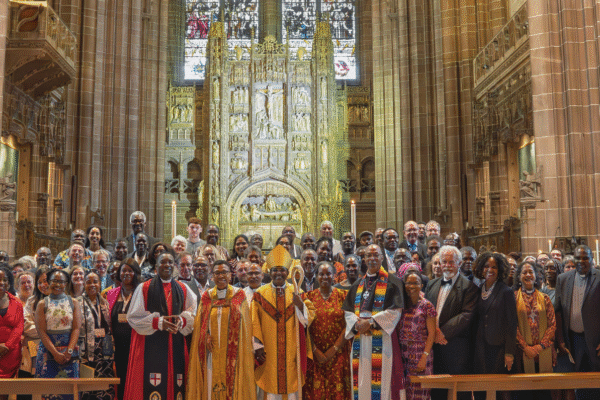
And on Sunday 18th October, Our Black History Month Eucharist service invites us all to the Cathedral to celebrate and embrace the verse that we are created in God’s image. Not “some of us, with reservations.” All of us. I will be preaching on that truth, leaning on scripture that keeps circling back to unity: “Behold, how good and how pleasant it is for brethren to dwell together in unity.” (Psalm 133:1)
“There is neither Jew nor Greek… for ye are all one in Christ Jesus.” (Galatians 3:28)
“For as the body is one, and hath many members… so also is Christ.” (1 Corinthians 12:12)
One body. Many parts. Nobody gets to sit this one out.
And on 9 November, we hold the Rivers of Memory memorial service, in partnership with the Good Funeral Company. This service honours the Africans who were enslaved and died at sea, people who were registered as cargo, dehumanised, deemed not worthy of remembrance. Rivers of Memory changes that. We will hold their memory with the reverence it was always owed.
The goal is to see Every church, chaplaincy, school and youth hub across the diocese chooses to make this October count. Weave it into your main Sunday services. Bring it into Sunday school and youth hubs. Let your youth services get loud and creative about it. If you run a church school, do not leave it to one assembly and a display board, though a good display board never hurt anyone. Get curious. Be inclusive. And please, do not be afraid of the difficult conversations. Black History Month is not only bunting and jollof rice, wonderful as both are. It is also a chance to ask honest questions about our shared past and our present, and to actually sit with the answers.
The Theme: Honouring Our Communities
This year’s Black History Month UK theme is “Honouring Our Communities.” We honour the Black community here in the diocese and the history, resilience and creativity that runs through it. We honour the ongoing work of racial justice, which is very much still ongoing, thank you for asking. And we honour our allies, the people who choose, again and again, to walk with us rather than watch from the sidelines.
As the Swahili say, “Umoja ni nguvu, utengano ni udhaifu”: unity is strength, division is weakness. And there is an African proverb worth pinning above your desk: “If you want to go fast, go alone. If you want to go far, go together.” We are going far this year together.
So Here is my Ask:
Do not come to Black History Month this year as a spectator. Do not tell yourself “this is not my history, so I will just stand at the back near the tea urn.” It is our diocesan history, all of it, and you are invited to actually be in it.
Bring your colleagues. Bring your church. Bring your family, your neighbours, the friend who still thinks Black History Month is only about one man and a dream speech. Come and see the fuller, richer, occasionally messy and thoroughly wonderful story we are all part of together.
Let us boldly celebrate. And let us commit ourselves, beyond October, to seeing racial equity across this diocese, so that all of us, every single one, may flourish.
See you at all our events. And go on, wear your traditional dress, as vibrant as it comes.”