14 Liverpool Youth Touch Down in Ghana for ‘Triangle of Hope’
Posted on
Home>News>14 Liverpool Youth Touch Down in Ghana for ‘Triangle of Hope’
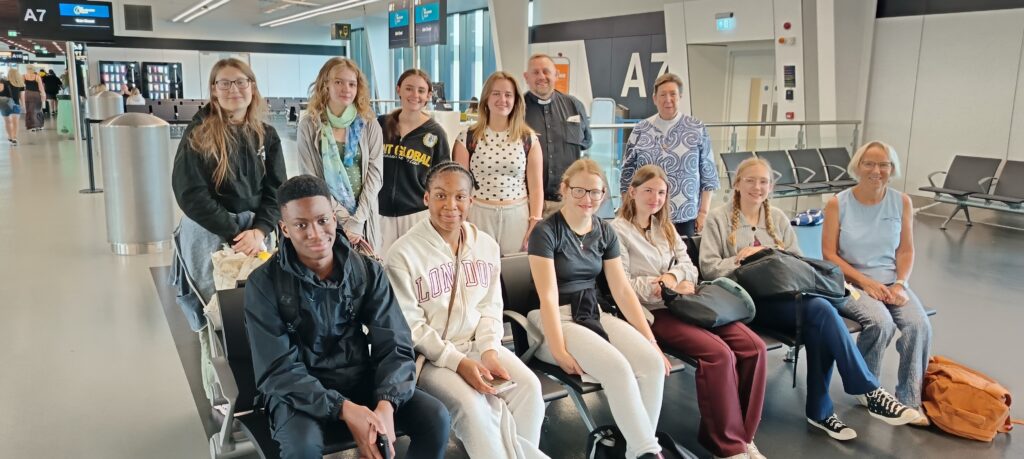
Our Liverpool group at Heathrow Airport.
Day 1 – Arriving in Ghana
After a 3am start from Liverpool, 14 young pilgrims from the Diocese of Liverpool have arrived safely in Ghana to begin their Triangle of Hope journey, accompanied by Canon Malcolm Rogers.
Joining groups from the Episcopal Diocese of Virginia and the Diocese of Ghana, the Liverpool pilgrims are beginning a week of friendship, faith, learning and reflection as the three groups come together to explore their shared history and look towards a future of reconciliation and hope.
Each day, a pilgrim has been tasked with writing a reflective piece on their journey.
To read their works, please continue scrolling.
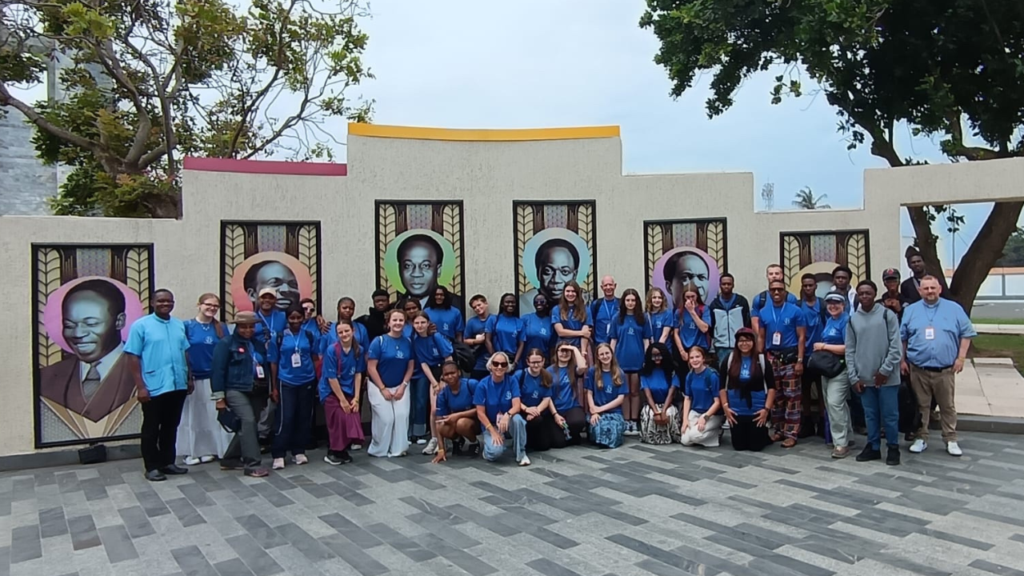
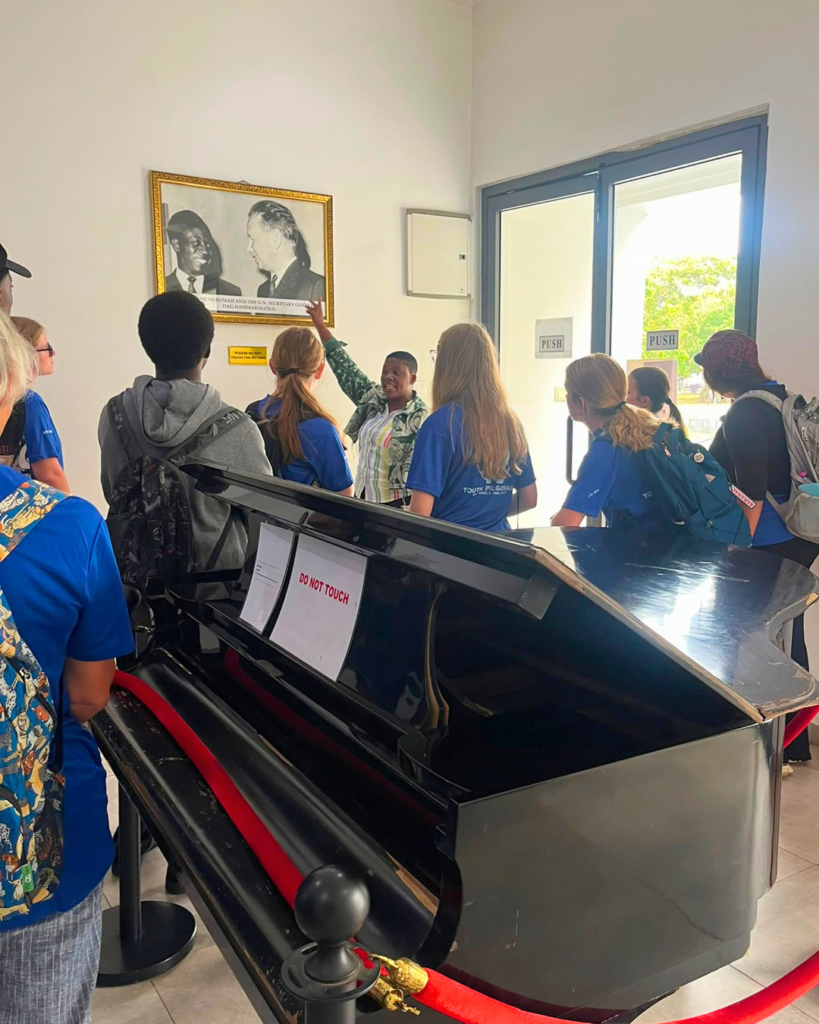
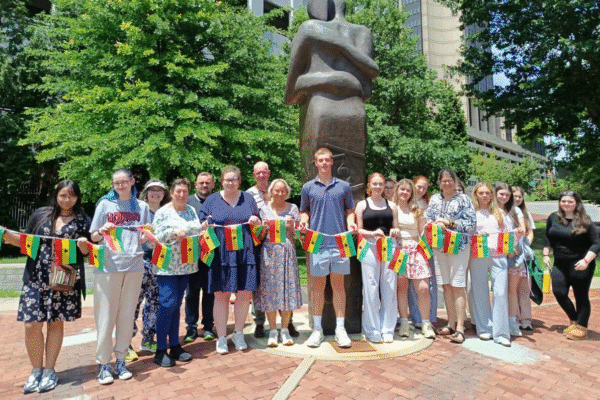
Group gathered behind memorial artwork for the late President Nkrumah.
Day 2 – Nkrumah Memorial Park
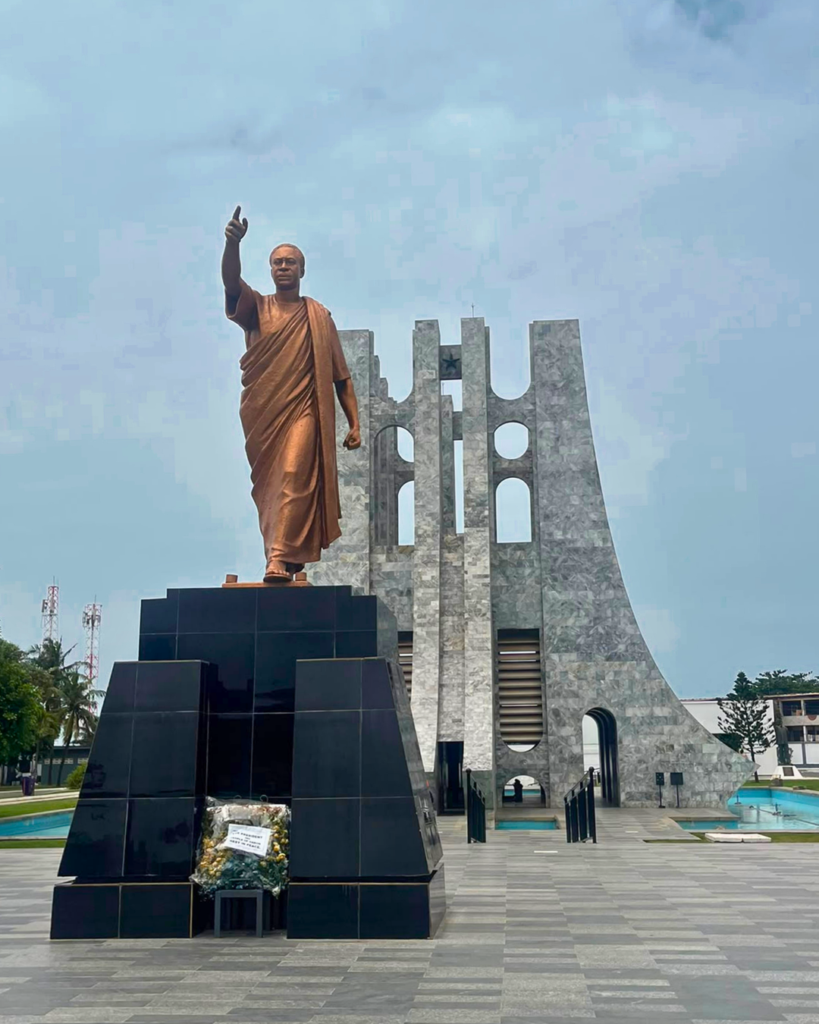
Today we visited the Nkrumah memorial park which was originally British land until Nkrumah the first president of The Gold Coast declared independence in March 1957 where Ghana got its name. What was interesting about this museum was the white painted sections in the building represented victory and the black painted sections of the building didn’t.
Nkrumah’s life was interesting before he became president of Ghana, he: * Got a teacher training degree and taught in Catholic schools in the Gold Coast * Received a B.A degree in economics and sociology from Lincoln , Oxford and Pennsylvania * Taught history and African languages at Lincoln university * Lived in London – attended London school of economics for one semester
For me personally this shows that he had a passion in many other things throughout his life and still managed to change the world with the passion he had for his country which is inspiring for young people and particularly the pilgrims throughout the three diocese on this pilgrimage proving that we can make a difference no matter what we do in our lives.
After lunch, we headed to the University of Ghana where we had a lecture from Professor Owusu who focused on the importance of healing and how generations are affected today from the horror of the past. He said “The Transatlantic Slave Trade was the foundation of racism today”. He referenced that “The Triangle of hurt is now a Triangle of Hope” which is something we focus on as a pilgrimage throughout our learning today.
We ended the day with dinner at our accommodation and a really intense game of imposter!
– Chloe
Day 3 – Journey to Cape Coast
This morning after breakfast we had a prayer walk around the prayer garden at the Anglican retreat Centre in Accra.
We walked in groups of three, representing each of the three Dioceses Of Liverpool, Virginia and Kumasi, reflecting upon the stations of the cross there.
I was struck by the details on each of the Stations.
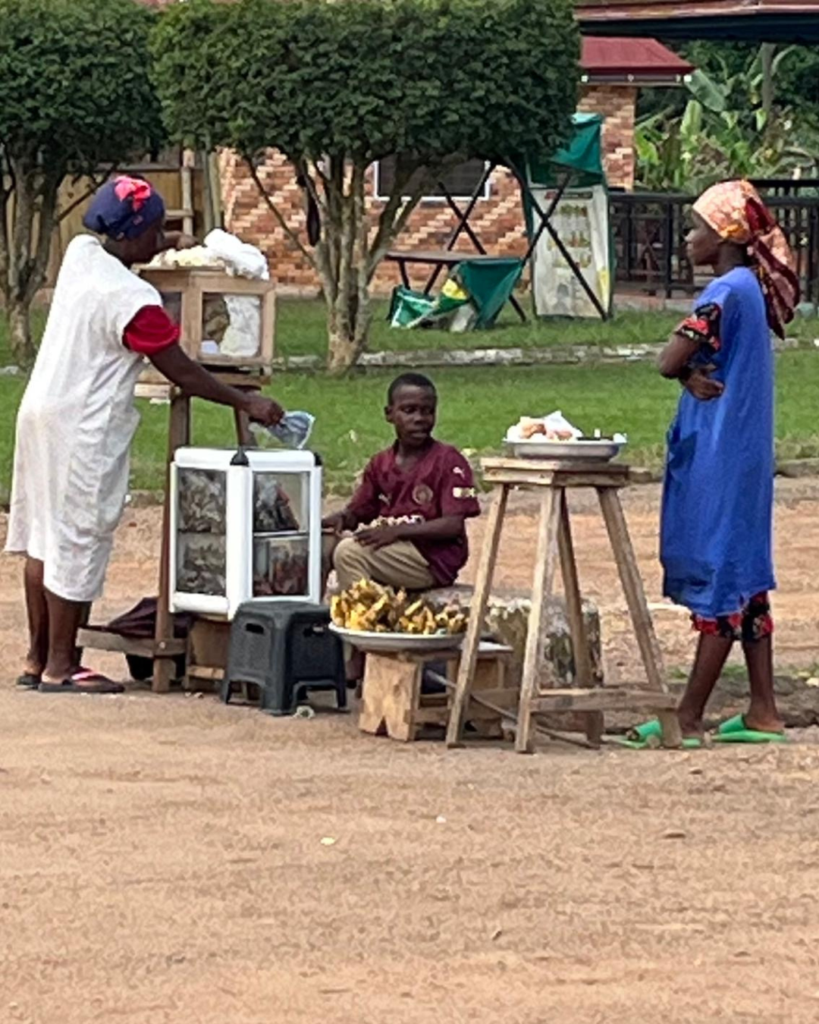
It was a long BUMPY bus journey from Accra to the Cape Coast and we stopped on the way to withdraw some cash and to buy some snacks for the journey. Along the route I saw women carrying peanuts, snacks, drinks and fruit on their head. Their loads looked heavy and I can’t imagine having to make a living that way. Others sold at tiny makeshift stalls at the side of the road.
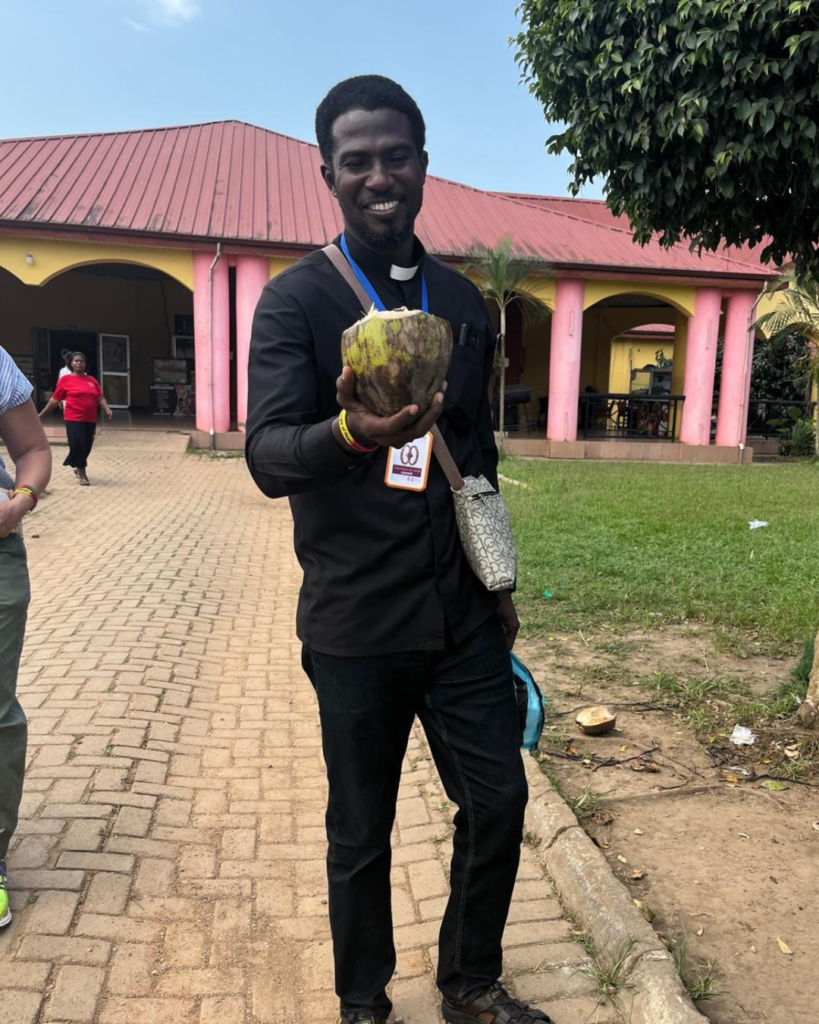
Their snacks included dried fried plantain and fresh coconut.
It was a relief to arrive at The Royal Elmount Hotel on the Cape Coast and over dinner we mixed together at tables of six, having two pilgrim representatives of each Diocese on the table.
In these groups we reflected upon such things as who our favourite Bible character was, what question we’d like to ask them and what film, song or book would sum up our faith journeys.
I enjoyed sharing with the others and learning about their faith, their culture and even what games they play.
Some much needed time was spent in the pool, continuing to build friendships while having fun.
It was a long, tiring day but real friendships were made and strengthened over our reflections and we look forward to developing those even more in the coming days of our pilgrimage.
– Mary
Content warning –The following paragraph contains material that some readers may find distressing. Reader discretion is advised.
The most harrowing thing about Cape Coast by far was its pristine beauty and location. From the white walls of the fort, and between the cannons, we could look out over the sparkling blue Atlantic ocean. The same waters that Canon Lee (an American pilgrimage leader) had called the ‘largest mass grave on earth’ not ten minutes prior. Even as we stood in the courtyard,! on the same stones where people’s lives were auctioned off, it was impossible to comprehend the weight of misery and oppression in such a sunny place.
Being caught in darkness is a common metaphor used by Christians to describe despair and hopelessness. It was this same feeling that came to me as we were plunged into the darkness of the slave cell, where enslaved Africans who fought back were taken and left, often to die without food or drink. I have tried to imagine how much pain there was in the not knowing, for all the enslaved people, who had no way of knowing their fate from one day to the next. Including the women who waited knowing any day they could be chosen for rape. Knowing this, the incredible courage it must of taken for the few who resisted, who took control of their own fate in the hope that it could be bettered. Or those who waited until the last minute, and chose the turbulent waters not even knowing what waited for them in the Americas, but refused to be parted from their home.
In the male slave dungeon, we lay a wreath in the farthest chamber, where they would have entered the tunnel bringing them out to the coast and the ships. It was simultaneously a contemplative and deeply upsetting moment, as we prayed together for the souls of those who lost their lives here, in the water, or beyond in the Americas.
Dear Lord of the impossible,
I know that you are eternally good and that goodness can transcend time;
Hear our prayer for those who rest and struggle here,
For those who lost their lives throughout the history of the transatlantic slave trade,
And those who continue to suffer by the hands of racism, oppression, loss of identity, and the bonds of modern slavery.
Help give us the strength to fight to free the world of hate,
And reconcile with our history, not just through sorrowfulness,
But by changing the world that is within our grasp.
Let us all live free in the love and light of God,
And rest easy the souls of those taken:
Nyame Adom (by the grace of god),
Never again.
Last bath
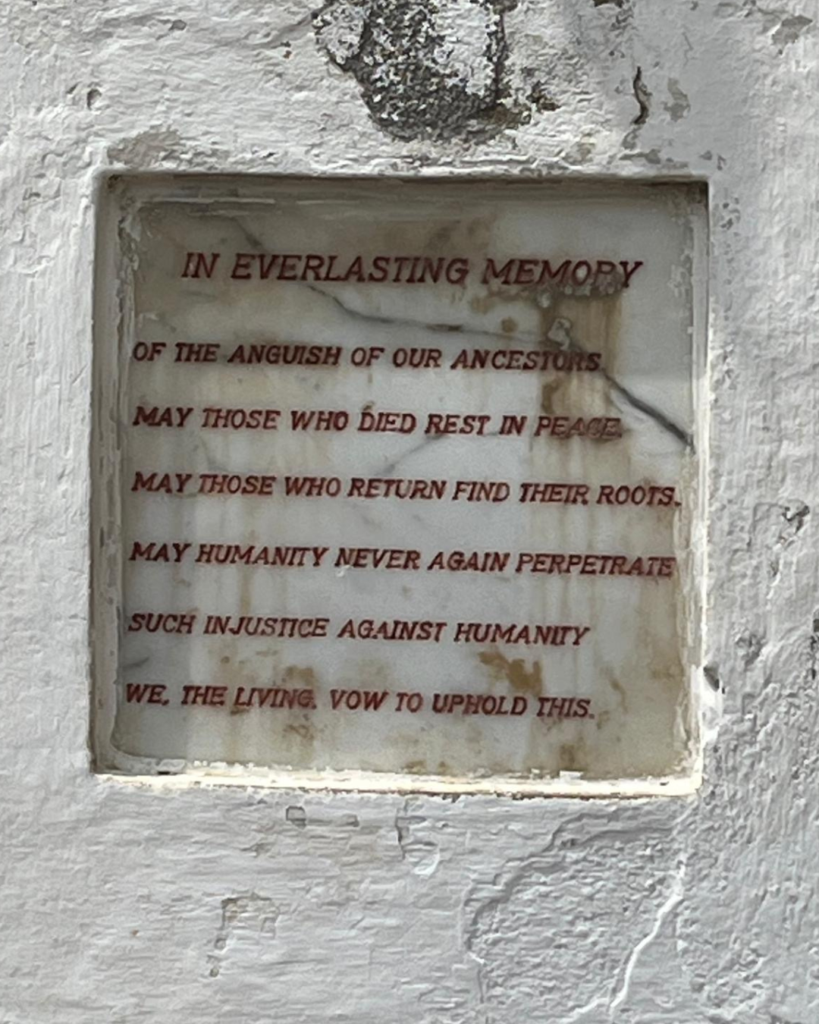
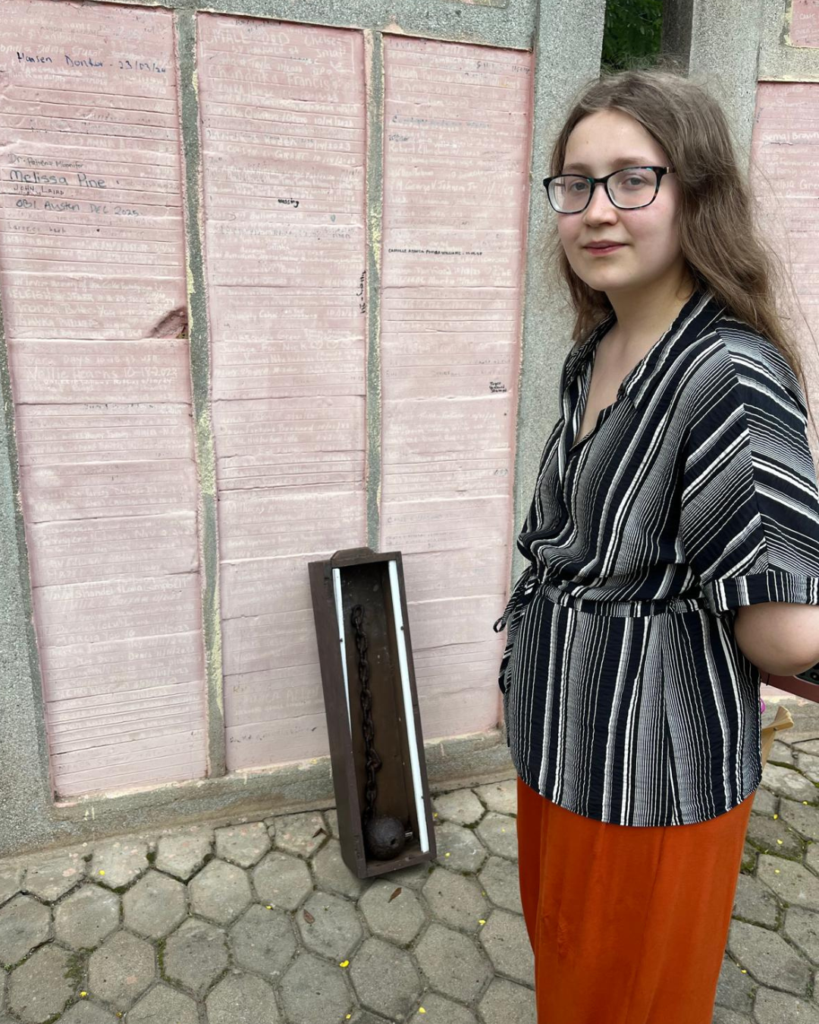
The last bath memorial sits on the grave site of the enslaved Africans who were too sick to be sold at market. It also memorialises those who did not make it in the long journey from their homes in the north to this place where the slave market once stood. The women who had been dripping their own blood down their legs, and the men who fought back and were beaten bloody. Our tour guide explained that, in order to distract the wild animals for a safe passage through the forest, the sellers tied these people to trees, to use them as bait.
As we took our shoes off, to walk the path that the sold Africans took for their last bath, I found myself overcome by the pain buried in the dirt beneath my feet. Not just the pain of the individual people, but the pain they must have carried with them: seeing their pregnant sister die alone in childbirth; their son left for the animals, hearing his cries echoing through the trees; their father tied to a heavy stone and thrown into the river they were to bathe in now. As we touched the water, I imagined the clear water as deep red with blood, like how the Nile was as Moses pleeded for his people to be set free from slavery.
This was the most difficult day of any of the pilgrimage so far. I repeatedly felt pulled by God to see things through these biblical means, reminding myself that the very perpetrators of this atrocity also considered themselves Christians. But I also through these feelings of anger, confusion, and despair, I feel even more responsible to humanity today. There were many people involved in the trade at the time who were not directly buyers or sellers, but were complicit for their own gain. I pray that I, everyone on the pilgrimage, all leaders, parents, and anyone reading this, can feel empowered and motivated to never be complicit in tragedy, and recognise where we can rewrite our future history with our own actions.
In the name of God, let it be done.
– Zo
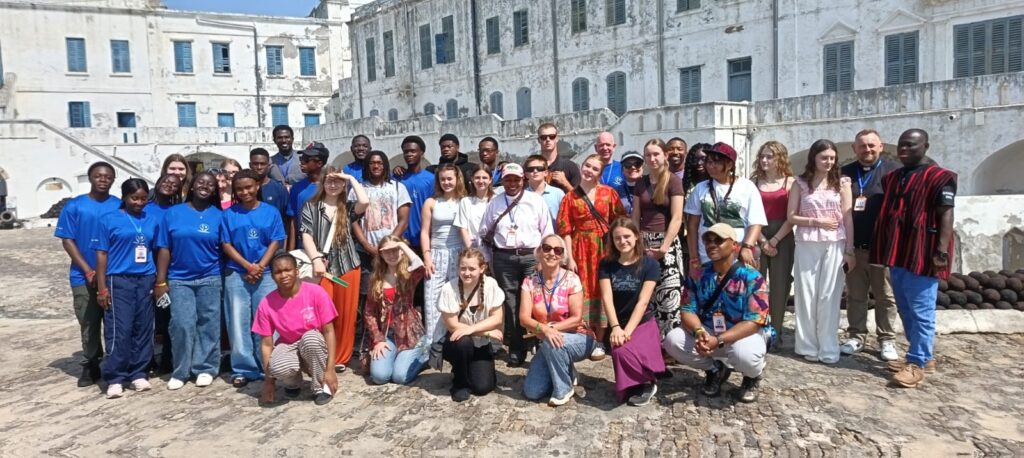
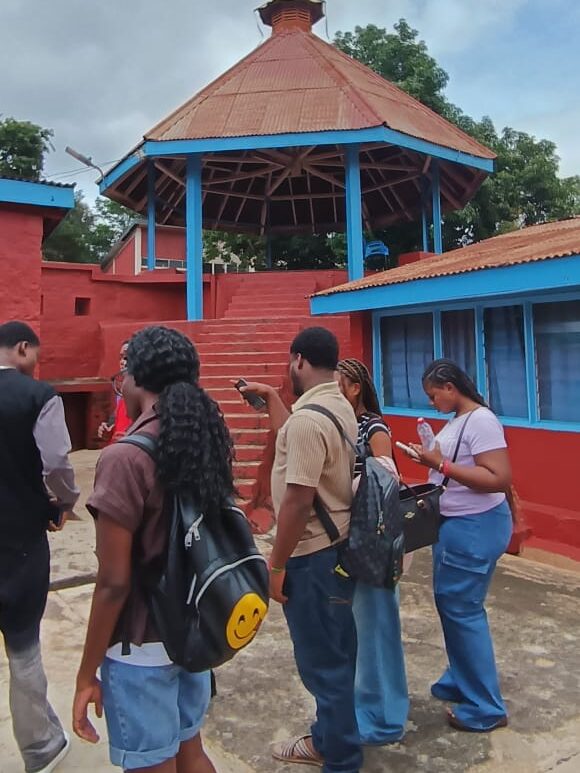
The group of pilgrims outside Cape Coast Castle, built for the slave trade.
Day 5 – Inspiring Day in Kumasi
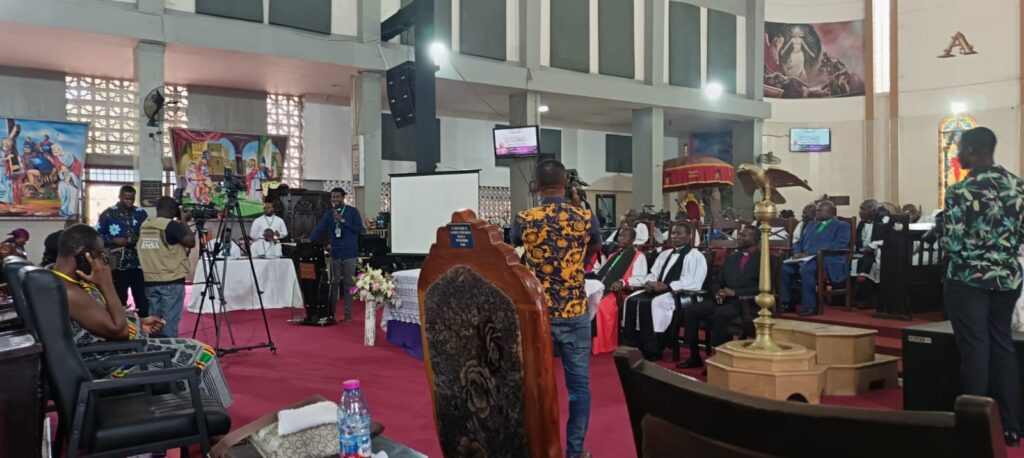
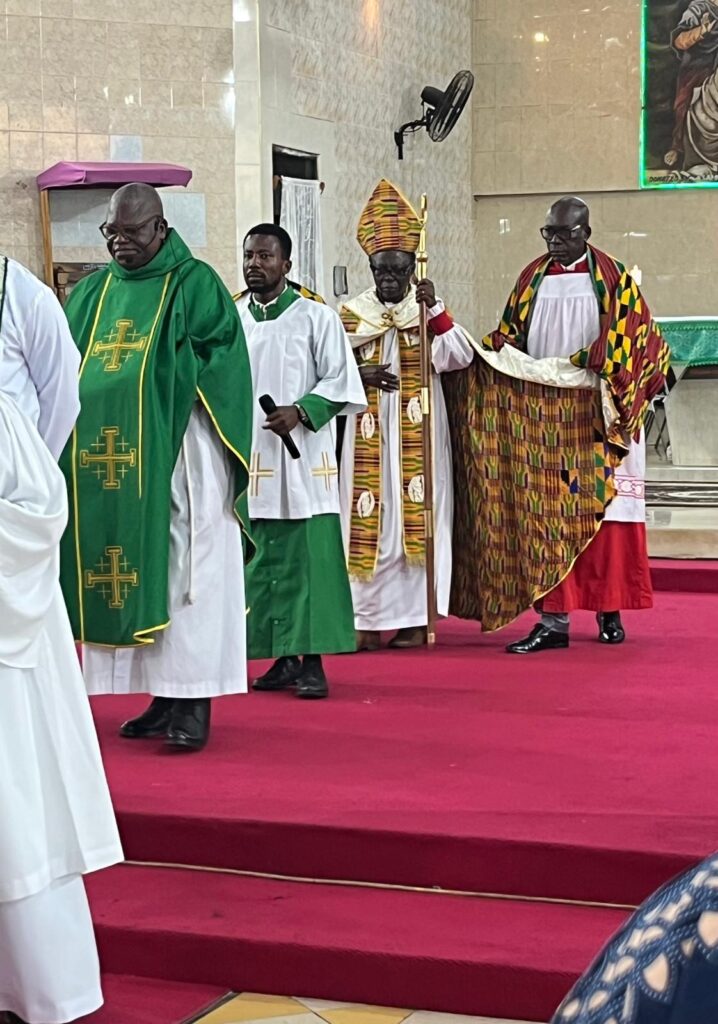
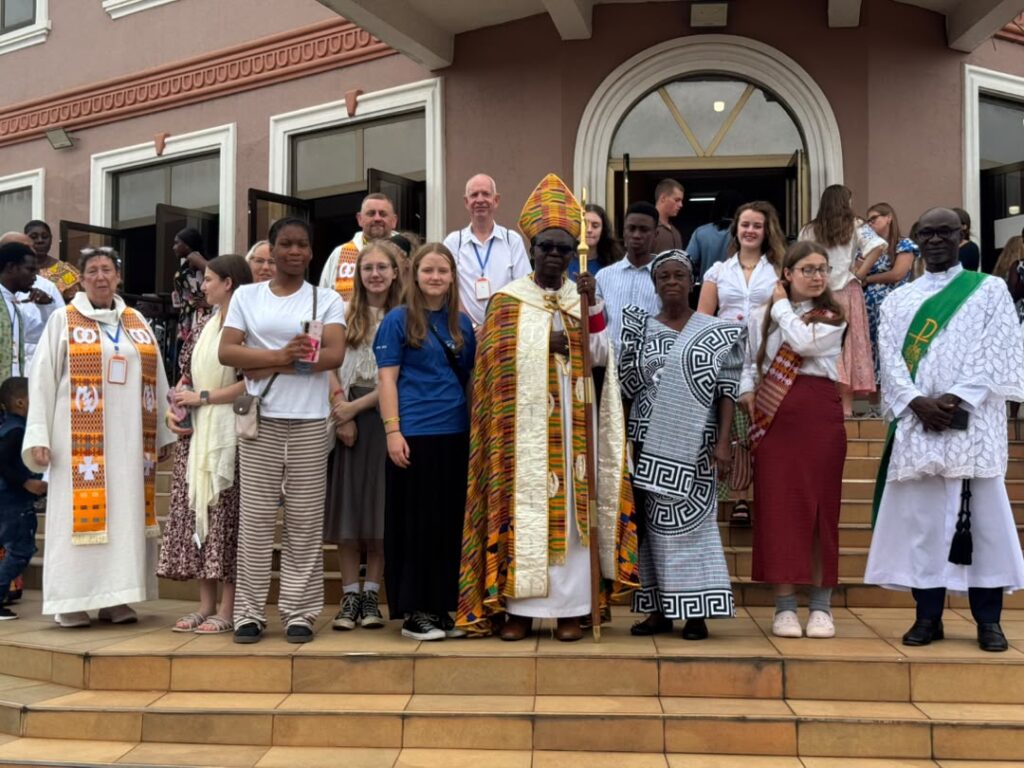
Today we were all tired after a long, emotional day of travelling yesterday and quite a late night. We started our day by visiting St Cyprian’s Cathedral as we had been invited by Bishop Oscar to attend and be introduced to Synod . We enjoyed the beauty of the cathedral and we were welcomed to the Synod by Archbishop Daniel Sarfo and Bishop Oscar.
All the pilgrims were delighted to learn that Reverend Father Nana Akwasi Kessie (the lead for the Kumasi pilgrims) has been appointed as one of the new Canons of St Cyprian’s Cathedral. It was amazing to reflect on how welcomed we were by all who attended. After we left the cathedral, we stopped off at a supermarket on the way to the palace to sample some snacks. Many tried some local food such as plantain, and others enjoyed snacks that brought us closer to home, like pringles.
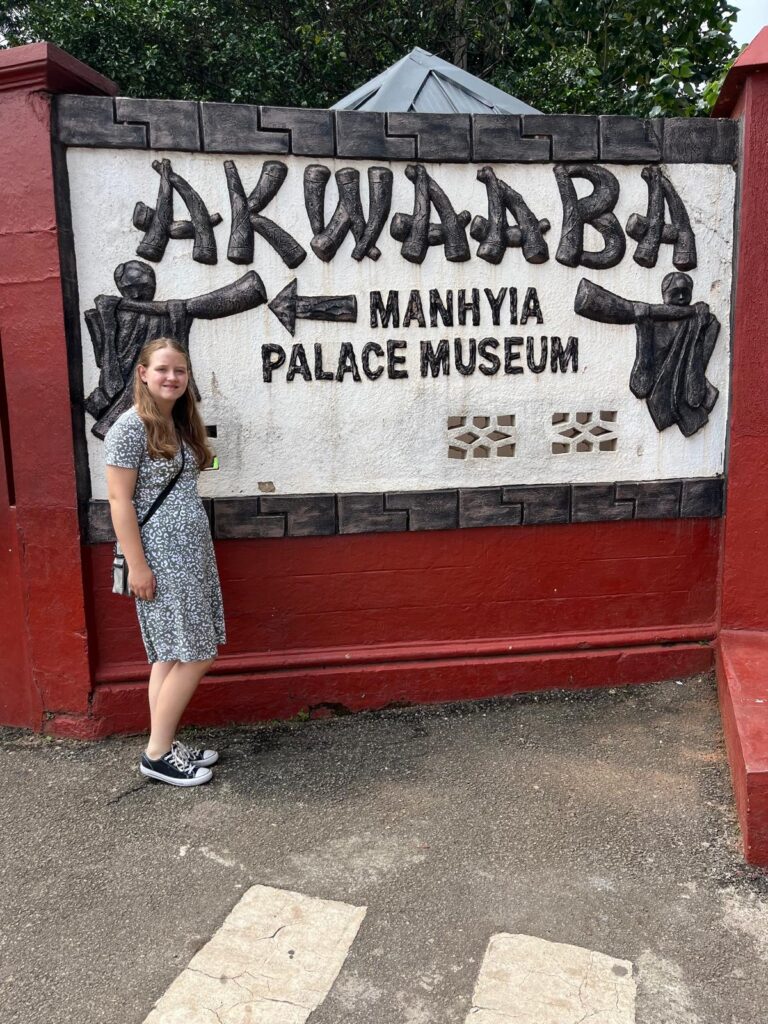
The afternoon brought us to Manhyia Palace Museum, which was home to many Ashanti kings. On our tour of the palace, we learned many things about the culture of the Ashanti people, such as the way drums were used for communication and the way the line of succession is passed down. The overall experience helped me to reflect on the traditional culture of Ghana, set aside from the Transatlantic trade as, despite this important event, Ghana is rich in history that is equally important to learn about. We ended our day reflecting in our group of Liverpool pilgrims by talking about our experience today. We finished with compline, which was excellently led by our very own pilgrim, Chloe.
– Emily
Diocesan Synod, live streamed on 3 TV channels!
Day 6 – Meeting Kente Weavers
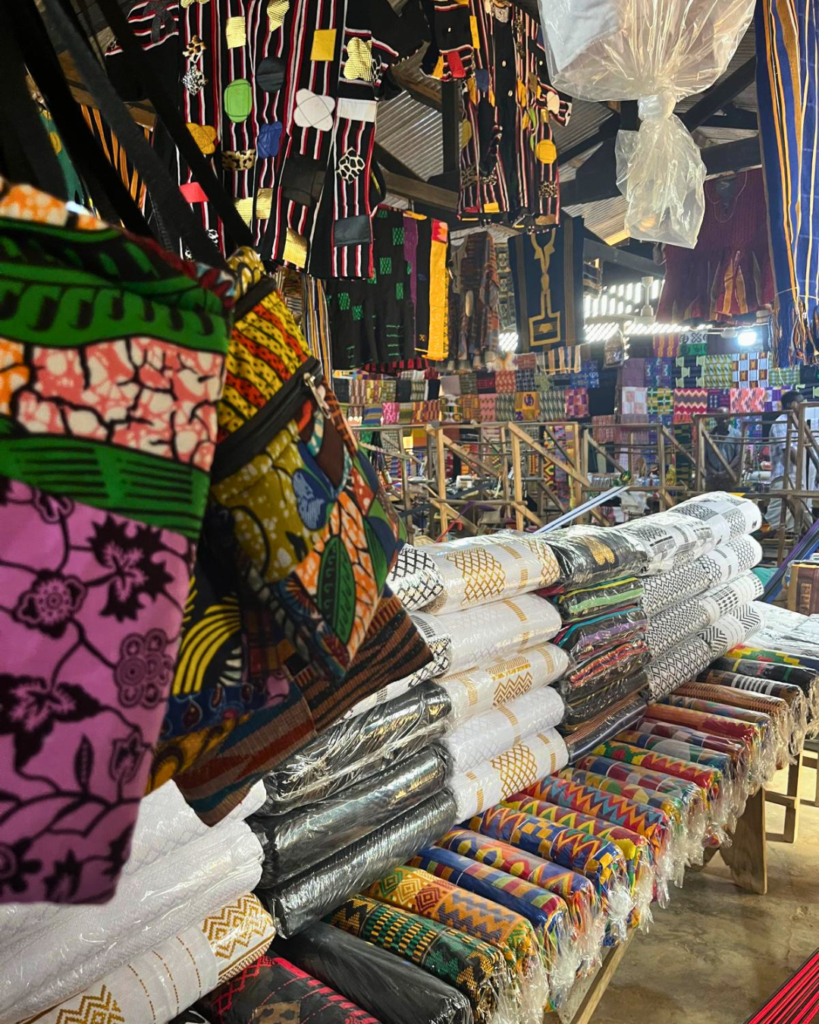
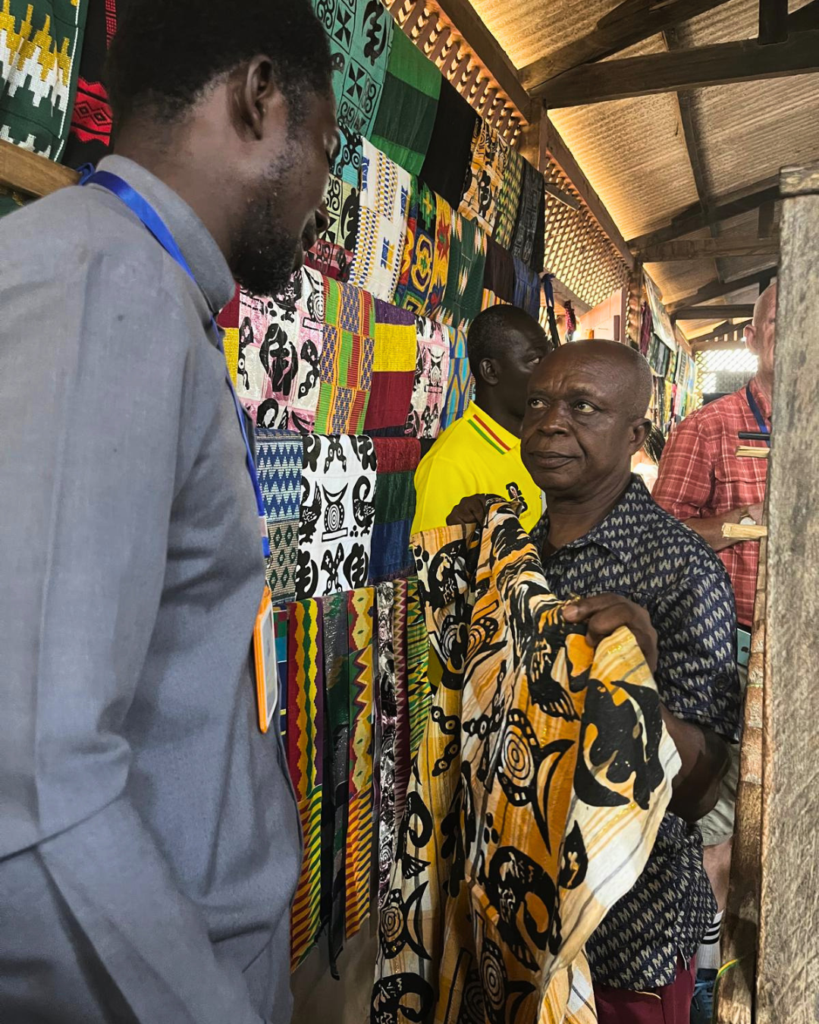
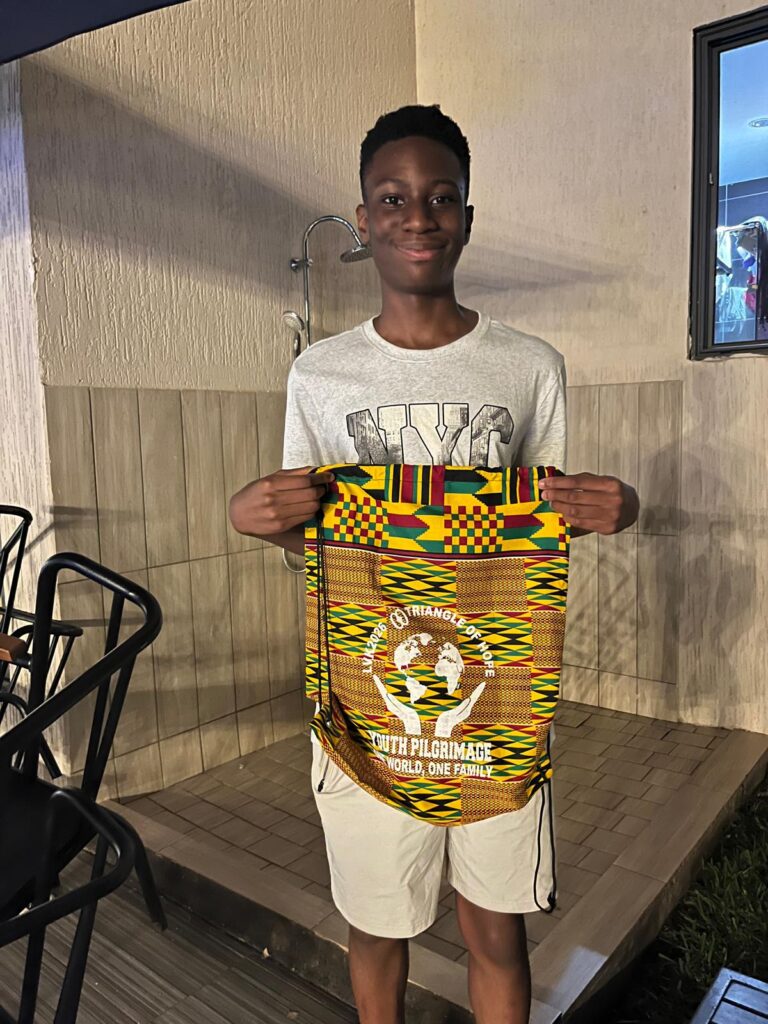
Today we visited Bonwire – a trading hall where independent Kente weavers sell a traditional Ghanaian fabric called Kente.
Before we entered a man who I presume had some sort of managerial position gave us a brief overview of the three types of kente; single, double, and triple weave. Each increasing in difficulty to make as you go along. He also explained that each design had a different meaning, for example, one pattern symbolised the golden stool, an incredibly significant object to the Ashanti people as it has been owned by their kings for generations. Each strip that was weaved was very similar in size and shape to that of a stole.
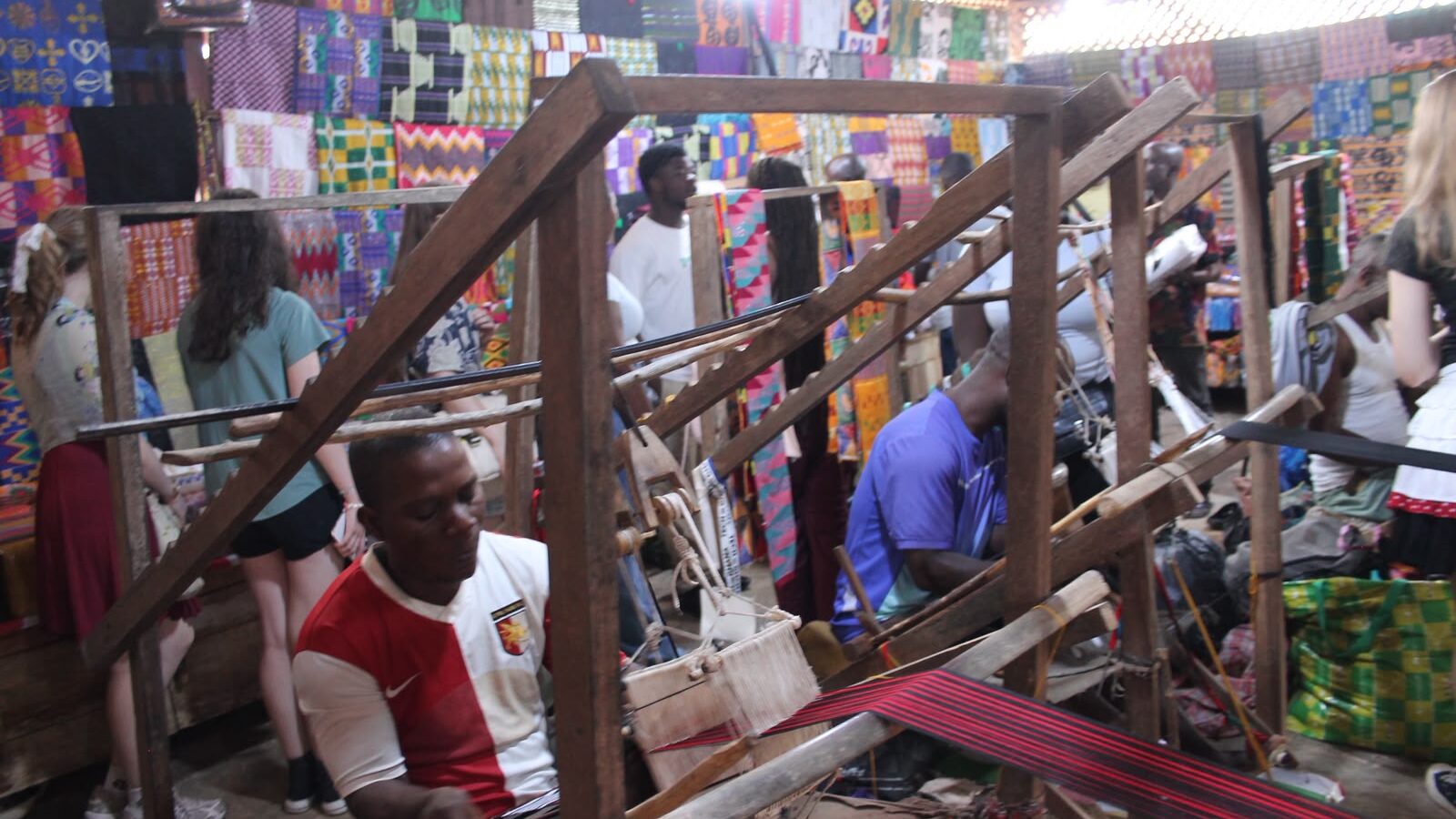
The building was a moderately sized hall, with walls covered with a myriad of different colours and patterns from all the kente that had been meticulously crafted by the traders with the centre being consumed by the looms used to weave the fabric. The traders were all very eager to give us all a chance to attempt to learn to weave. Many people, including myself, had a go at it and I think we all gained an appreciation for those who do this every day as it takes a lot of effort to push the pedals needed to weave the cloth and to be able to do this from 6am till 5pm every day is incredibly impressive.
When buying things from market stalls such as these ones, it is a large part of Ghanaian culture to barter the price and considering the lack of this in the UK we were relatively not very good at it. As a result Canon Nana Kessi was very busy haggling the prices down for everyone. This was very entertaining to watch and in the end we we all managed to get an array of different cloths for reasonable prices.
Despite the exiting nature of this visit, there was very much a bittersweet atmosphere as you were talking to the traders because we were paying 200 cedis or about £13 for a cloth that would have taken them a full day to make. In the uk this is below minimum wage for an hour so to think that these traders are having to live on less than an hours wage for a full day, many of whom will have families to feed, is quite heartbreaking. Many of the trader’s children were also outside asking for money and it was incredibly heartbreaking to tell them no. As we come back to the uk many of us are wanting to find a Ghanaian children’s charity to help other kids in a similar situation.
Once we got back we had a relaxed afternoon as we had just had a couple of incredibly tiring days but in the evening we had an evening prayer with all 3 groups. I found this a really nice way to reflect on the day and bond through God with the other parts of the pilgrimage as we are approaching the end of the trip which, for many of the pilgrims, is their last leg on the Triangle of Hope.
– Lucy
Kente weavers in Bonwire, Ghana
Day 7 – Military Museum & Meeting Bishop Oscar
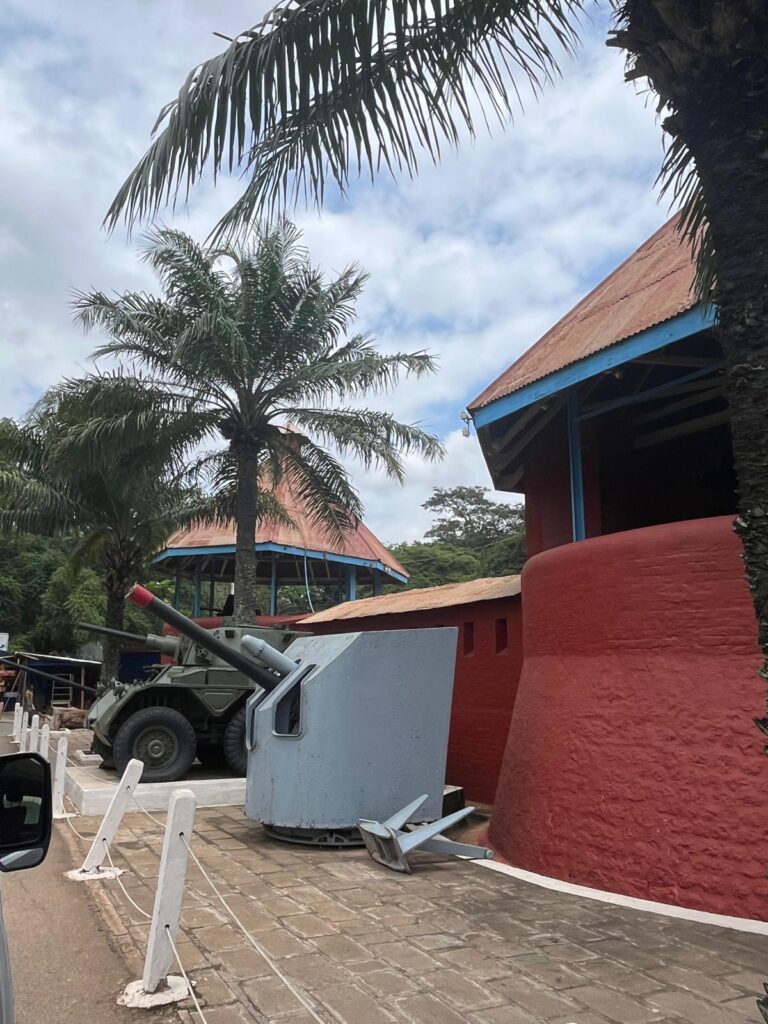
During my pilgrimage, I visited a military museum in Kumasi. I learnt about the role of the Gold Coast in the First World War and how Britain was involved. I also learnt about Japan’s role in the war and its connection with Britain.
The museum had lots of interesting military equipment and uniforms on display. All the equipment really helped me learn much more about what soldiers used and what military life was like.
After visiting the museum, I went to a local market. It had lots of different shirts,bags etc. Luckily I got a Ghana jersey there for a cheap price.
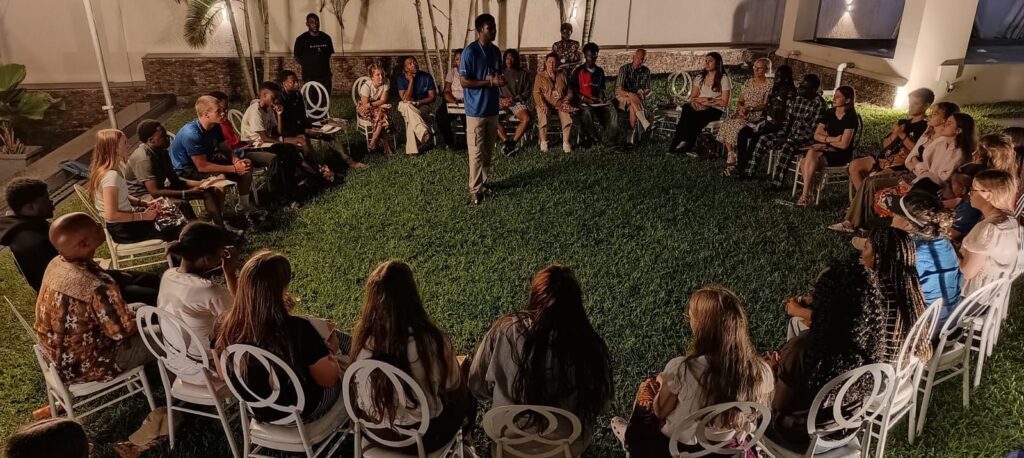
At the end of the day, we had dinner, and afterwards, we all gathered together in a circle and shared what we were grateful for during the pilgrimage. It was a very nice way to end the day because we could reflect on everything we had experienced, learned and enjoyed together. I also got to greet Bishop Oscar and even take a picture with him, it was a very memorable moment for me and my mum will surely be proud.
Before he left us, Bishop Oscar commissioned and blessed all the pilgrims using the prayer: The peace of God, which passeth all understanding, keep your hearts and minds in the knowledge and love of God, and of his Son Jesus Christ our Lord: And the blessing of God Almighty, the Father, the Son, and the Holy Ghost, be amongst you and remain with you always. Amen
– Benjamin
Circle of reflection and to share our experiences
Day 8 – Saying Our Goodbyes
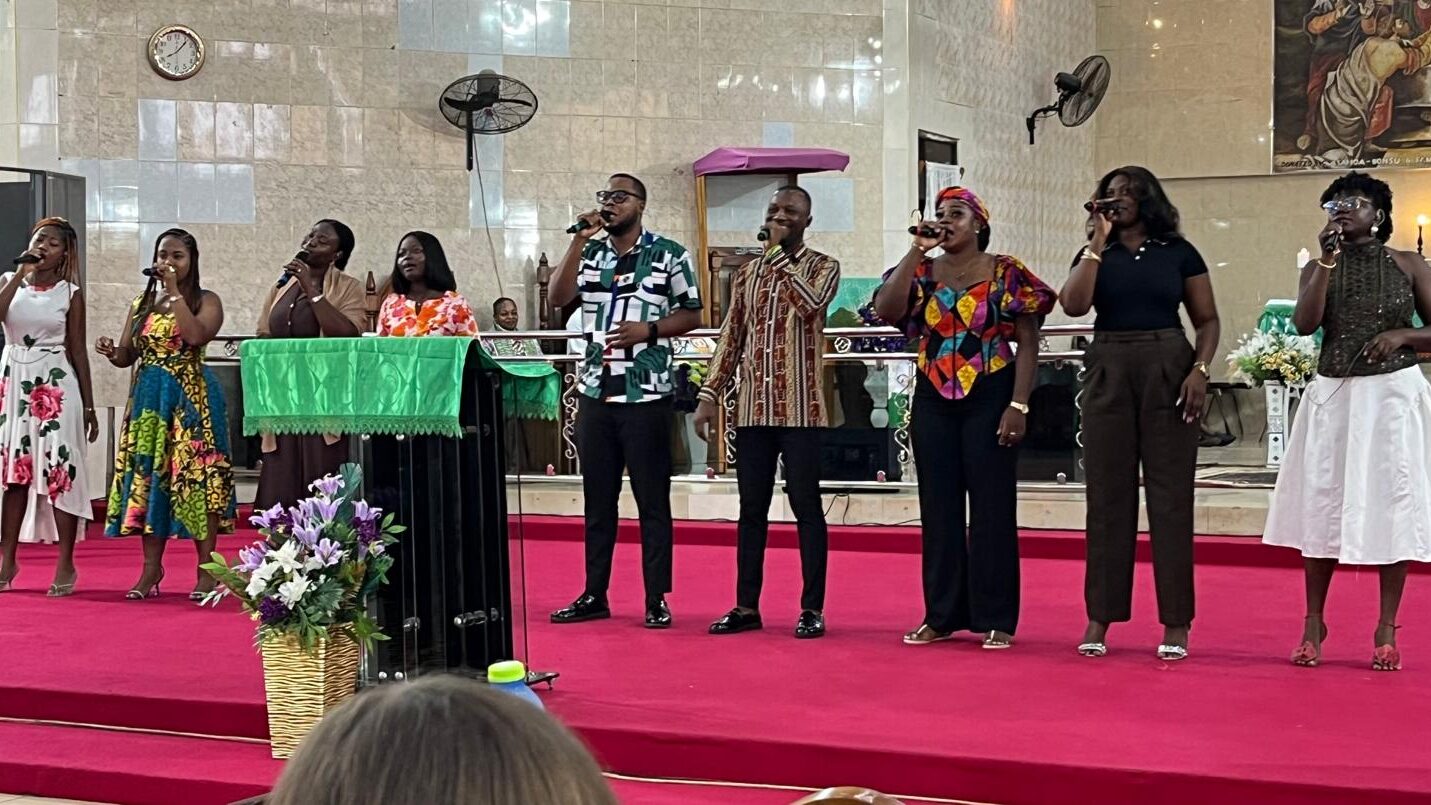
This morning we had a church service at St Paul’s on the Hill which started at 7:30am. The service was really fun and interesting, as we got to worship in a different way than we do back home. It was very lively and included a lot of singing and dancing, which made it feel very welcoming. During the service, Canon Malcolm and fellow pilgrim Chloe sung “Yet not I but through Christ in me” together, which was very beautiful and made a couple of people tear up.
After the service, we had a very emotional lunch, as it was also our time to say goodbye to our American and Ghanaian pilgrims after a long, challenging emotional and spiritual journey together. The goodbyes included a lot of long hugs and tears, as well as giggles as we realised how silly we looked. After it was just the Liverpool pilgrims left at the Hotel, we all talked about how much we are going to miss our fellow pilgrims from Kumasi and Virginia, and are excited to see the ones returning next year.
Half an hour later, our leaders cheered us all up by taking us to the Kumasi Mall, where we got to spend the rest of our money on snacks in Shoprite. We spent most of our time in an Ice Cream Shop where we played a lot of football and enjoyed a lot of laughter.
We ended the day with a pizza party with Canon Nana Kessie’s family, as well as a couple of the Ghanaian leaders. Then the pilgrims had a night full of board games, popcorn, and reflection! We thank God for our pilgrimage and all our fellow pilgrims as we prepare to return home.
– Phoebe
Service in St Paul’s, Ghana
Day 9/10 – Coming Home
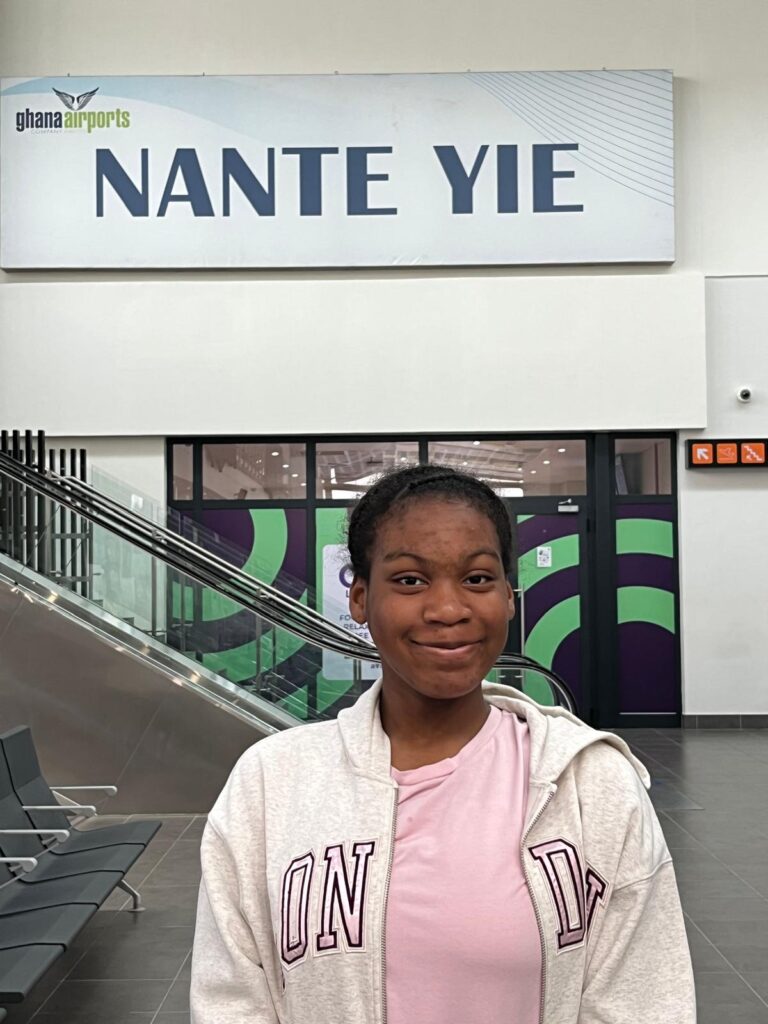
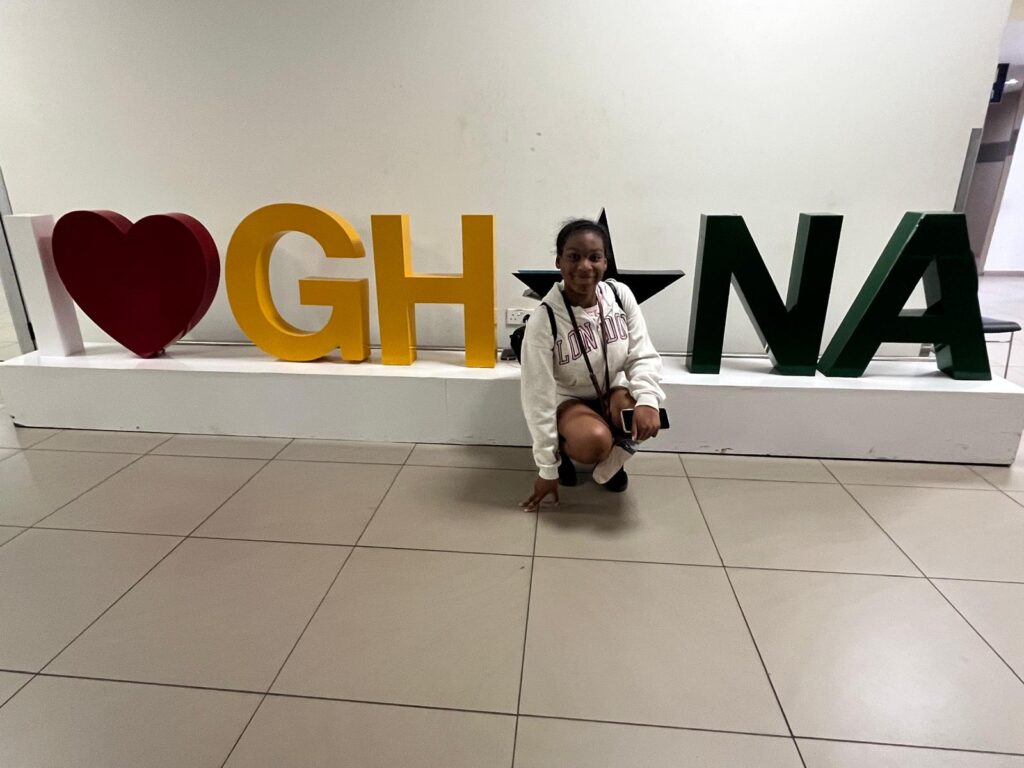
Today is our final day in Kumasi and we were headed to Kumasi airport at 12:30 after lunch. During our 10 days in Ghana I have learnt so many new things like their history and culture that I didn’t know about before so all of the facts we learnt were very significant and important.
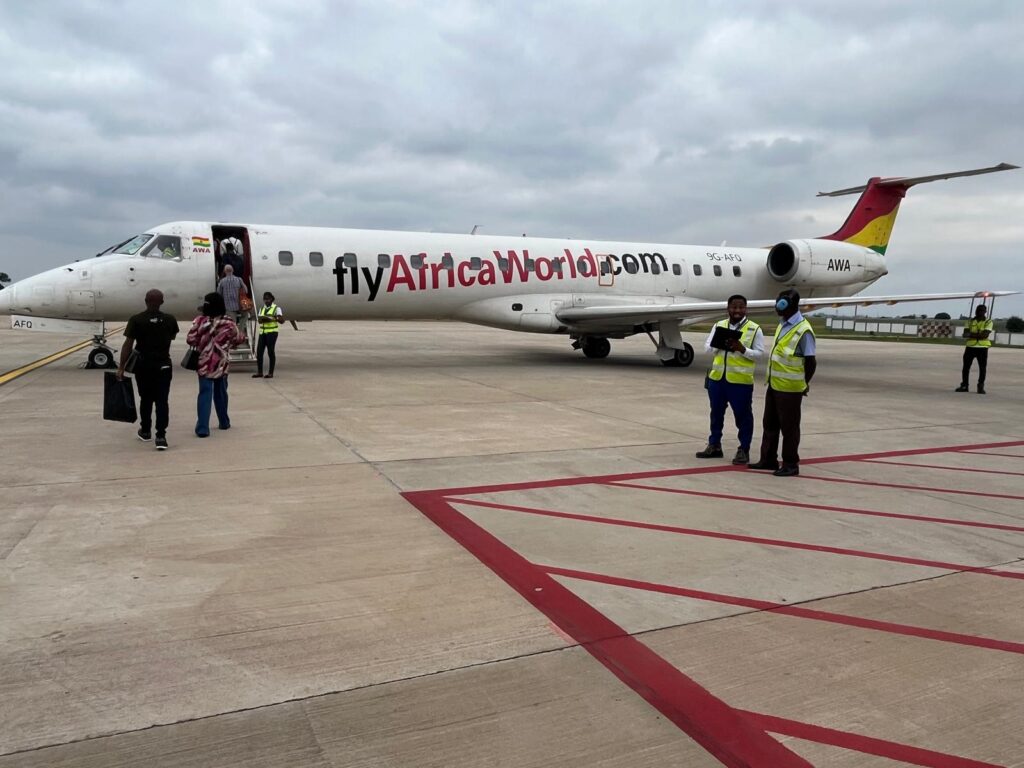
As we arrived at Kumasi Airport, we all took our bags through the check-in, waited for half an hour then safely boarded the plane. The plane was smaller than a usual plane but, the seating was actually very comfortable. They gave me cream crackers as a snack and a mixed fruit drink that I really enjoyed and wish I had again.
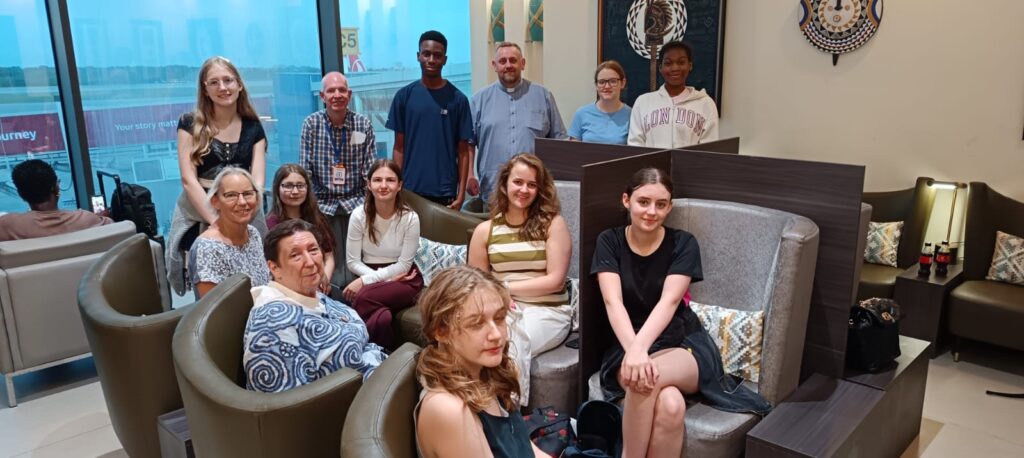
Later, we arrived in Accra and we were welcomed to an executive lounge with free drinks, food and Internet. I found it way more comfortable than the airport seating, and I am very grateful to Canon Mal for preparing this for us.
Finally, we left the lounge at 9 pm to head to the gate and board the plane to London, Heathrow.
We were very sad about leaving Ghana as it was a very memorable journey and that we will not see some of the pilgrims from Virginia Liverpool and Kumasi for the next Pilgrimage but the experience was very fun, significant and important for all of the pilgrims. I felt very proud for being able to communicate with the other groups and achieving my goals.
– Joanna
Our Pilgrims in Kumasi Airport
Back in Liverpool
After a long journey for many of us, all of the pilgrims from Kumasi, Liverpool, and Virginia are finally home, sharing their experiences from this past week with their families and loved ones.
After such an eventful week, coming back had felt so abrupt and sad as we knew that was the last time we would see many of our fellow pilgrims, and it was the end of such a wonderful experience for those we had grown close to over the time we had we them.
When I got home, I shared the wonderful stories and pictures of the places we got to see and learn from, as well as those of all of us having fun together and helping us to manage all of the difficult emotions induced by hearing such harrowing truths.
As the final day came to a close, I had some familiar pizza and chicken – I think I’ve had enough rice to suffice me for quite a while now!
I asked my mum to share about her experience watching this journey from home: ‘We have loved reading the blogs from all the pilgrims. It was an amazing insight into their experiences from their own perspective. Reading the blogs, we were moved learning about the atrocities – it is powerful that the pilgrims sharing their stories can reach a further audience via social media, consequently helping others to understand the history of the Transatlantic Slave Trade. It is clear from our chats since Hannah has returned home how much she has learnt and experienced and we know this is only going to be further developed with her continued involvement with the next stage of the Pilgrimage.’
We are all so grateful for everyone who helped us make it to this point, thank you for supporting us on our pilgrimage!
– Hannah
What is the Triangle of Hope?
The Triangle of Hope is an Anglican-led effort to form covenantal community between the dioceses of Liverpool (England), Accra (Ghana), and Virginia (USA) dedicated to transforming the long history, ongoing effects and continuing presence of slavery in our world through repentance, reconciliation and mission. Each one of our Dioceses was directly involved in the dreadful Slave Triangle, so the ‘Triangle of Hope’ is a chance to remember and acknowledge with sorrow that human beings were captured and enslaved for financial gain with no regard for their dignity and humanity. Pilgrims join together to explore and view this history with great pain and in penitence before God, the God who wills in Christ to bring freedom and justice for all.
Following the Journey
To keep up-to-date with what our pilgrims are doing in Ghana, we will continue to upload images from the students on our Facebook page.
Please join us in wishing them well as they continue their journey of faith, learning, friendship and hope.