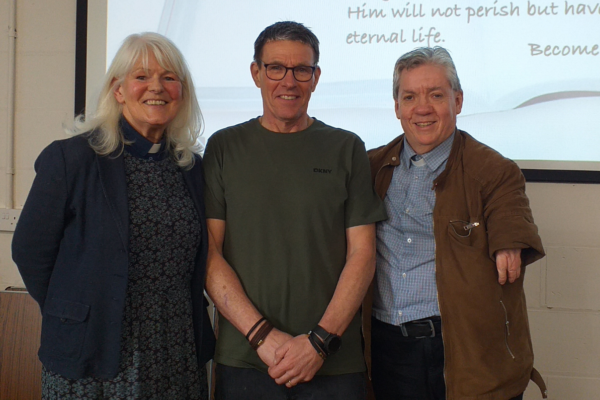
Caroline describes herself first and foremost as someone who has always had a heart for mission. Before stepping into her current role, she worked as a GP and later began exploring ministry through Reader training – a process she says took years of discernment.
“I spent about six years trying to work out that call,” she reflects.
Her training journey formally began in 2020, just as the pandemic hit. Despite the disruption, Caroline continued forward, completing two years of training and being licensed as a Reader in 2022. But alongside this, something else had already been growing.
“I think I’ve always had a missional heart… it was the thing that fitted me like a glove.”
That instinct became clearer through what Caroline describes as noticing the “gaps” in church life – particularly the absence of children and families.
She recalls this with a striking image:
“If you think of a train coming into a station and you hear ‘mind the gap’, everyone carefully steps over it. I think that’s what we’d been doing in church – stepping over the gap and carrying on.”
That gap became impossible to ignore in early 2024, when an unexpected change meant families and young children suddenly began attending Sunday services at St Luke’s. The church, however, wasn’t prepared nor set up for them – there was no children’s space, no clear welcome, and no obvious way for them to engage.
Rather than seeing this as a challenge, Caroline saw an opportunity.
“If they’re there, then we’re there to plant the seeds for God to grow.”
She began by focusing on the barriers, not just for children, but for parents too, many of whom had little to no church background. She recognised how intimidating traditional church spaces can feel and wanted to create something more accessible for the younger generations who were now walking through the doors of St Luke’s.
“It was about helping people come into church at a level they could understand.”
From that starting point, something began to grow.
What began as occasional attendance quickly became something more regular. Families who initially came along for practical reasons such as school admissions began to return week after week, choosing to stay connected.
To support this, Caroline stepped into her new role as a Local Missional Leader and began shaping a new kind of worshipping community: Café Church.
Still in its early stages, Café Church meets monthly and is already welcoming between 40 and 50 people – many of whom are new to church.
“It’s given us the opportunity to create something that’s really shaped around the people who are coming.”
Alongside this, Caroline has been walking alongside members of the community in their faith journeys, supporting younger adults through discipleship and confirmation. Some of those individuals are now stepping into leadership themselves, forming a growing team around the vision.
What stands out in Caroline’s story is that none of this began with a grand plan. It started with noticing a problem, responding to it, and evolving to find a clear and workable solution.
Her journey into missional leadership wasn’t about having everything mapped out – it was about recognising where God might already be at work and choosing to join in.
Through the support of the Diocese, and the structure of the Local Missional Leader pathway, Caroline has been able to flourish, while remaining rooted in her local community.
Her story is a reminder that calling doesn’t always begin with certainty. Sometimes, it starts with simply noticing the gap and choosing not to step over it!
If you feel a similar sense of calling, or are beginning to notice where God might be prompting you, the Diocese of Liverpool offers remarkable support and guidance to help you explore what role or training is perfectly suited to you and your personal needs.
To find out more, visit our Lifecall Page or get in touch via lifecall@liverpool.anglican.org.